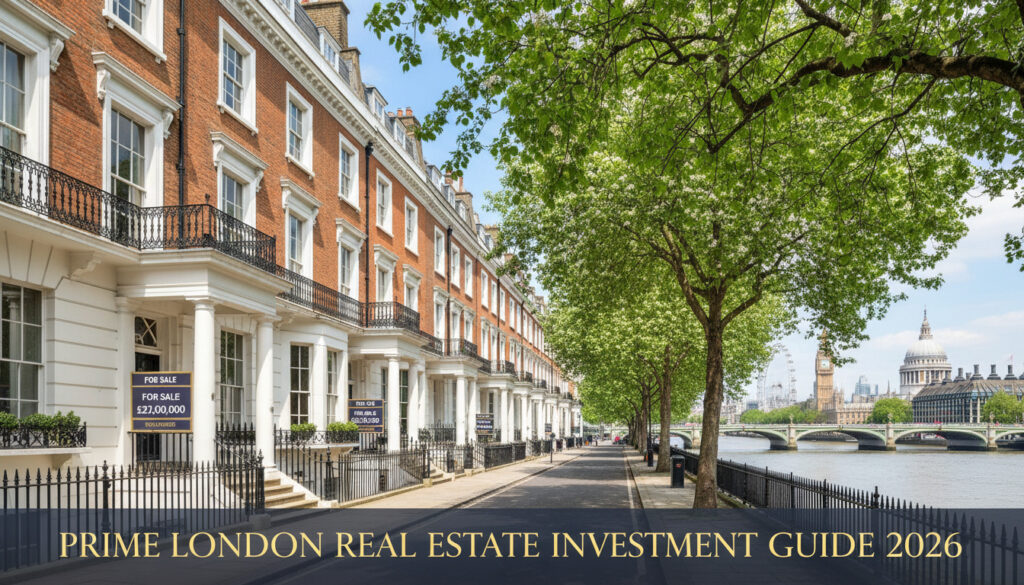
Property for Sale London – Prices, Best Areas and 2026 Guide
London’s property market entered 2026 under mixed conditions, with the average house price settling at £551,000 as of December 2025, marking a 1% annual decline from the previous year. While the capital continues to lag behind national growth trends, distinct patterns emerged across property types and boroughs, creating varied opportunities for prospective buyers.
The disparity between markets remains stark. Prime central London properties traded at average discounts of 9.3% during the first quarter of 2025, while family homes in the £600,000 to £1 million bracket demonstrated remarkable resilience. Supply constraints persist, with only 12,000 new homes approved in 2024 against a required 20,000, intensifying competition in transport-linked outer boroughs.
This guide examines the current landscape for property for sale in London, analysing official Land Registry data alongside market indices to provide accurate pricing, identify high-potential areas, and outline the practical steps for securing a home in the capital.
Best Areas to Buy Property in London
- December 2025 data from HM Land Registry places the average London property at £551,000, down 1% year-on-year.
- Prime properties in Kensington and Chelsea recorded average discounts of 9.3% in Q1 2025, with 82% of transactions selling below asking price.
- Family homes priced between £600,000 and £1 million maintained the strongest market position throughout 2025.
- First-time buyers faced average purchase prices of £471,000, reflecting a 1.6% annual decrease.
- New build properties averaged £509,000 and showed positive growth at +0.8% annually, outperforming resale stock.
- Supply shortages continue, with 2024 seeing only 12,000 new home approvals against a target of 20,000.
- Outer boroughs connected to Elizabeth Line extensions, particularly Camden and Hackney, showed enhanced demand from younger buyers.
| Property Type | Average Price | Annual Change |
|---|---|---|
| Detached | £1,136,000 | -0.6% |
| Semi-detached | £715,000 | +2.9% |
| Terraced | £638,000 | +1.7% |
| Flat/Maisonette | £430,000 | -3.6% |
| New Build | £509,000 | +0.8% |
| Resale | £549,000 | -2.5% |
| First-time Buyer | £471,000 | -1.6% |
| Cash Buyer | £585,000 | — |
| All Properties | £551,000 | -1% |
Current Property Prices in London
Property values across London demonstrated significant variation throughout 2025, influenced by type, location, and buyer profile. Plumplot data covering March 2025 to February 2026 indicates an average of £650,000 across 73,800 sales, though this includes both older homes at £649,000 and new builds at £688,000.
Price Disparities Across Property Types
Detached properties commanded the highest averages at £1,136,000 despite a modest -0.6% annual decline. Semi-detached homes showed stronger momentum at £715,000 with a 2.9% increase, while terraced houses averaged £638,000. Flats and maisonettes experienced the most significant pressure, dropping to £430,000 following a 3.6% annual decline.
Prime Market Performance
The luxury segment faced particular headwinds. Coutts Prime Property Index recorded a 2.6% quarterly decline in Q1 2025, placing values 1.6% below the prior year and 10.8% off the 2014 peak. Buyers in this sector frequently secured properties at significant reductions from asking prices.
First-time buyers purchased at an average of £471,000 in December 2025, representing the most accessible segment when compared to cash buyers at £585,000. Targeting flats and maisonettes, which averaged £430,000, may offer additional savings, though this category saw the steepest annual decline at 3.6%.
Types of Properties for Sale in London
The capital’s housing stock spans Victorian conversions to contemporary skyscrapers, each segment responding differently to current economic conditions. Understanding these distinctions proves essential for targeting appropriate listings.
Flats and Apartments
Flat prices softened considerably by late 2025, with market updates suggesting drops of 7-10% from previous highs. This correction reflected oversupply in certain postcodes and changing work patterns reducing demand for central pied-à-terre units. East and South Central London offered particular value for budget-conscious buyers.
Family Houses
Houses experienced more moderate corrections of 4-5%, with the £600,000 to £1 million bracket maintaining relative strength. Semi-detached properties in outer boroughs benefited from infrastructure improvements, particularly Elizabeth Line expansions enhancing commuter connectivity.
New Build Developments
New construction represents the only growth sector, recording +0.8% annual appreciation despite higher initial price points. Developer incentives and government schemes enhanced accessibility, though buyers should verify build quality and service charges before committing.
Prime and Luxury Residences
Kensington, Chelsea, and Westminster maintained the highest premiums, though current conditions favour buyers with currency advantages. Dollar-denominated buyers particularly benefited from exchange rate dynamics combined with the prevalent 9.3% average discounts.
Market data indicates new builds averaged £688,000 in broader surveys, while Land Registry figures cite £509,000. These discrepancies likely reflect different measurement periods and completion stages, with premium central developments skewing independent market analyses higher than official transaction records.
How to Buy Property in London
Navigating London’s purchasing process requires preparation across financial, legal, and logistical domains. Current market conditions favour prepared buyers capable of moving quickly or negotiating from positions of strength.
Financing Requirements
Mortgage availability improved throughout 2025, though 65% of first-time buyers continued facing significant entry barriers. Cash buyers averaged £585,000, while mortgaged purchases required substantial deposits given London’s price points. 0% Credit Cards for Property Purchases may assist with ancillary costs, though they cannot cover deposit requirements.
First-Time Buyer Considerations
First-time buyers benefited from average prices of £471,000, below the overall market mean. Government schemes provided partial relief, though the removal of stamp duty relief for first-time buyers on higher-value properties post-April 2025 increased upfront costs for many. Focusing on outer boroughs and emerging zones near tech hubs offered viable entry paths.
Negotiating in a Softening Market
With 82% of prime transactions involving discounts and flat prices declining 7-10%, buyers gained unusual leverage. Researching comparable sales through Land Registry data strengthened negotiating positions, as did demonstrating chain-free status or mortgage pre-approval.
Research indicates 65% of first-time buyers face significant entry barriers despite available mortgage support. Higher stamp duty rates implemented post-April 2025 have further complicated affordability calculations for premium market segments, contributing to reduced transaction volumes in higher price brackets.
London Property Market Timeline
- Early 2025: Market opened with averages around £540,000, recording 3.2% year-on-year growth driven by limited supply in central areas.
- Q1 2025: Prime property values declined 2.6% quarterly, sitting 1.6% below prior year levels and 10.8% off the 2014 peak.
- April 2025: Stamp duty increases took effect, dampening activity in higher price brackets despite stable mortgage rates.
- Late 2025: Flats experienced substantial corrections of 7-10%, while houses saw more moderate declines of 4-5%.
- December 2025: Land Registry data confirmed average prices at £551,000, down 1% annually and 0.8% monthly.
- 2026 Outlook: Forecasts suggest UK prices could rise up to 5%, with prime central London seeing 3% growth as activity increases.
What We Know and What Remains Uncertain
Established Facts
- Official Land Registry data confirms December 2025 average of £551,000
- Prime market discounts averaged 9.3% in Q1 2025
- New builds are the only property type showing positive annual growth
- Supply shortages persist with 40% deficit in required approvals
Remaining Uncertainties
- Exact trajectory of flat price recovery following 7-10% declines
- Impact of future Bank of England rate cuts on transaction volumes
- Long-term effects of April 2025 stamp duty changes on mobility
- Whether outer borough growth can sustain current premiums
Economic Context Shaping the Market
London’s property landscape reflects broader economic pressures including interest rate fluctuations and constrained construction pipelines. The Elizabeth Line’s continued expansion fundamentally reshaped accessibility patterns, boosting values in previously secondary locations like Hackney and Camden while reducing premiums for traditional Zone 1 addresses.
Post-2025 stamp duty modifications altered buyer behaviour, particularly in the £500,000 to £1 million bracket where marginal rates increased. This policy shift contributed to market bifurcation, with activity concentrating at price points either below threshold levels or sufficiently high to absorb additional costs.
Buyers preparing properties for sale should consider climate adaptation measures. Installing Best Portable Air Conditioners for London Homes addresses increasing summer temperatures while providing temporary cooling solutions during viewings and renovations.
Sources and Data Integrity
“The UK House Price Index for December 2025 indicates that London remains the region with the lowest annual growth, while average prices reached £551,000, reflecting specific localised pressures distinct from national trends.”
— HM Land Registry Official Statistics
“First-time buyers in London face unique affordability challenges, with our data showing 65% encountering significant barriers to entry despite government support schemes and improved mortgage availability.”
— Market Analysis Reports 2025
Summary
London’s property market presents a complex picture for 2026, characterised by falling average prices but rising opportunities in specific segments. First-time buyers benefit from declining flat values and government schemes, while family homes in transport-connected outer boroughs show resilience. Prepared buyers with financing in place can leverage current discounts, particularly in prime markets, though supply constraints ensure competition remains fierce for well-located stock.
Frequently Asked Questions
Where can I find properties for sale in London?
Major portals including Rightmove and Zoopla list available properties, though direct engagement with local agents often provides early access to off-market opportunities in supply-constrained areas like Kensington and Camden.
Are there cheap properties for sale in London?
Flats averaged £430,000 as of December 2025, representing the most affordable entry point, particularly in East and South Central London where prices corrected 7-10% during late 2025.
Are there new build properties for sale in London?
New builds averaged £509,000 according to Land Registry data, showing positive growth of 0.8% annually. Developer incentives often include stamp duty contributions or furniture packages to offset higher initial costs.
What are luxury properties for sale in London?
Prime central London properties in Kensington and Chelsea command premium prices but currently trade at average discounts of 9.3%, offering opportunities for qualified buyers despite the £1 million-plus typical entry level.
Which areas offer the best value in South London?
Emerging zones near improved transport links in South London offer value following infrastructure investments, though specific postcodes vary significantly. Focus on areas benefiting from Elizabeth Line connectivity for long-term growth potential.
How long does the buying process take in London?
The purchasing process typically requires three to four months from offer acceptance to completion, though chain-free or cash purchases can conclude within six weeks. Leasehold flats may require additional solicitor time for managing agent enquiries.
More related posts
 Travelodge London Central City Road – Location, Reviews and Booking
 Green Goblin – Complete Guide to Origin, Powers and Movie Appearances
 Jasveen Sangha – Sentenced to 15 years for Matthew Perry’s overdose
 Ironing Service Near Me – Costs, Types and How to Choose
 11 Stone in Pounds – Exact 154 lb Conversion Guide
 USD to GBP Rate – Live Dollar to Pound Exchange Guide
 One Pound to INR – Live Rate, History and Transfer Guide
