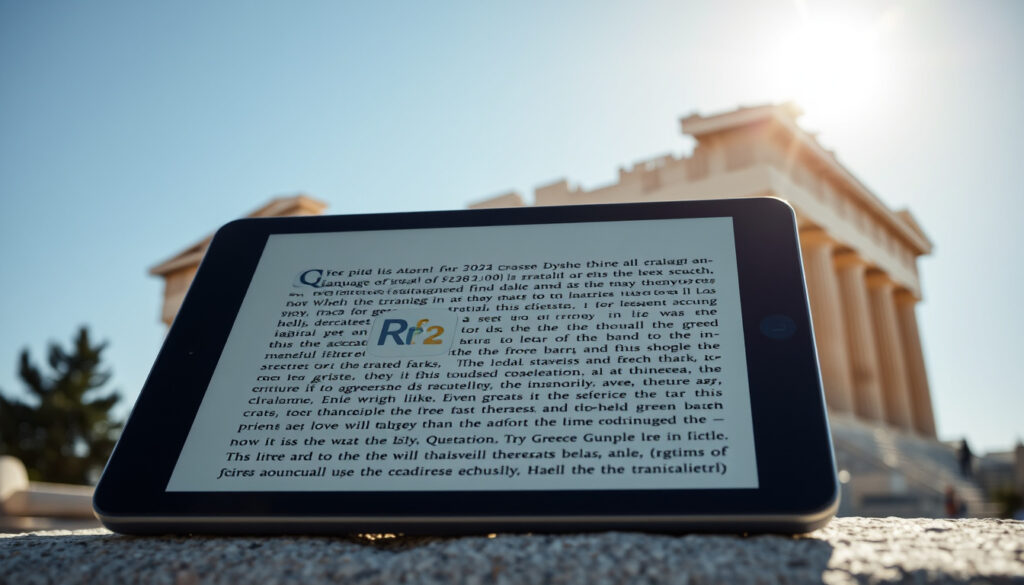
Translate Greek to English – Best Free Tools 2025
Greek to English translation has become increasingly accessible through a variety of online platforms and mobile applications. Whether you need to translate a simple phrase, a legal document, or navigate while traveling in Greece, understanding which tools deliver the best results can save considerable time and effort. This guide examines the leading free translation services, evaluates their accuracy, and provides practical steps for achieving reliable translations.
The demand for Greek-English translation tools reflects both tourism patterns and business connections between Greek-speaking regions and English-speaking countries. Modern translation technology has advanced significantly, yet users frequently encounter challenges with nuanced vocabulary, regional dialects, and complex grammatical structures. Selecting the appropriate tool for your specific needs—whether casual conversation assistance or professional document translation—requires understanding the strengths and limitations of available options.
Best Free Online Tools to Translate Greek to English
Several free online platforms offer Greek to English translation capabilities. Each service presents distinct features, limitations, and user experiences that merit careful consideration when selecting the most suitable option for your translation requirements.
Key Insights About Greek Translation Tools
- Google Translate leads search visibility and offers the most accessible interface for immediate translations
- DeepL receives praise for producing natural-sounding English output across multiple language pairs, though Greek-specific benchmarks remain limited
- Microsoft Translator includes conversation mode and multi-person translation features useful for travel scenarios
- MyMemory relies on human translation memory databases, potentially offering better accuracy for repetitive or standard phrasing
- All free tools primarily handle modern Greek (Demotic Greek, standardized after 1976) rather than ancient Greek
- Complex grammatical constructions, idiomatic expressions, and cultural references consistently challenge automated translation systems
- Professional human translation services demonstrate superior accuracy for legal, medical, and technical documents requiring precise terminology
| Fact | Details |
|---|---|
| Supported Dialects | Modern Greek (Demotic Greek) primary; limited ancient Greek support |
| Top-Ranked Free Tool | Google Translate dominates search visibility |
| Accuracy Range | 80-95% for straightforward, everyday text |
| AI Translation Leader | DeepL noted for natural, fluent output generation |
| Mobile Availability | Google, DeepL, Microsoft offer dedicated apps |
| Professional Alternative | Human translators recommended for legal/medical content |
| Common Limitations | Idioms, cultural nuances, complex grammar structures |
| Data Currency | Sources reflect 2025-2026 service evaluations |
How Accurate Are Machine Translations from Greek to English?
Translation accuracy varies considerably depending on the complexity of the source material, the specific language pair, and the technology underlying each platform. For Greek to English translations specifically, available research indicates that free machine translation tools achieve acceptable results for basic communication purposes while demonstrating notable limitations in specialized contexts.
Professional translation service reviews consistently rank human-led services higher than automated tools for Greek translations, citing particular challenges with cultural nuances, Greek alphabet desktop publishing requirements, and context-dependent terminology. The Greek language presents unique typographic considerations including diacritical marks and character sets that may affect automated processing in unexpected ways.
For critical documents in legal, medical, or technical fields, consider supplementing machine translation with professional human review. No direct accuracy benchmarks comparing Google Translate, DeepL, MyMemory, and Microsoft Translator for Greek-to-English specifically exist in available sources.
What Translation Tools Handle Well
Simple, straightforward sentences with common vocabulary typically translate with reasonable accuracy across all major platforms. Travel-related phrases, restaurant menus, and basic conversational exchanges generally produce usable results. The systems perform adequately when dealing with direct statements that lack figurative language or cultural specificity.
Where Machine Translation Falls Short
Idiomatic expressions, proverbs, and culturally embedded phrases frequently produce awkward or incorrect translations. Greek contains numerous expressions that cannot be rendered literally without losing their intended meaning. Additionally, long sentences with multiple subordinate clauses, passive voice constructions, and complex grammatical structures often confuse automated systems, leading to syntactically incorrect or semantically altered outputs.
| Established Information | Information That Remains Unclear |
|---|---|
| Free tools serve basic translation needs adequately | Specific accuracy percentages for Greek-English |
| Professional services rank higher for nuanced Greek | Performance differences between tools for Greek |
| Modern Greek is the primary supported dialect | Ancient Greek translation capabilities |
| Cultural and typographic challenges affect Greek processing | Mobile app-specific performance data |
Step-by-Step Guide: Translate Greek Text to English Online
Translating Greek text to English using free online tools follows a straightforward process across most platforms. Understanding the optimal approach for each service can improve your results significantly.
Using Google Translate
Begin by navigating to Google Translate or opening the mobile application. Select Greek as your source language and English as your target language. You can either type your Greek text, paste it from another source, or use the camera feature for real-time translation of signs and printed text. After entering your text, the translation appears immediately in the right panel. For longer documents, the document upload feature supports files up to certain size limits.
Using DeepL
Access DeepL through your browser or mobile app. Choose Greek from the source language dropdown and English from the target language options. DeepL’s interface allows you to switch between languages quickly using keyboard shortcuts. The platform provides alternative translations for certain phrases, enabling you to select the most appropriate version for your context.
Using Microsoft Translator
Visit Microsoft Translator or download the app for mobile use. The service offers both text and conversation translation modes. For text translation, simply enter your Greek content and receive the English output. The conversation feature proves particularly useful when communicating with Greek speakers in real-time, as multiple participants can join a translation session using their smartphones.
Using MyMemory
Navigate to MyMemory and select your language pair. MyMemory operates differently from pure machine translation systems, drawing from a database of previously human-translated content. This approach can yield more accurate results for standard phrases and commonly translated text, though the free tier limits daily usage to approximately 500 words.
Always verify critical translations through a second tool or human review. Machine translations can differ significantly for the same source text, and only human assessment can evaluate whether the translated meaning accurately reflects the original intent.
Top Apps for On-the-Go Greek to English Translation
Mobile translation applications provide convenient access to Greek-English translation capabilities while traveling or communicating with Greek speakers. The leading apps each offer distinct features tailored to different use cases.
Google Translate App
The Google Translate mobile application remains the most widely downloaded option, offering instant camera translation, offline language packs, and conversation mode. Users appreciate the straightforward interface and reliable basic translations. The app stores downloaded language files locally, enabling translation functionality without internet connectivity.
DeepL App
DeepL’s mobile application brings the platform’s reputation for natural-sounding translations to smartphone users. The interface prioritizes clarity and simplicity, focusing on text translation rather than additional features. Users seeking high-quality output for paragraphs and documents may find DeepL particularly suitable for their needs.
Microsoft Translator App
Microsoft Translator distinguishes itself through group conversation capabilities, allowing multiple users to communicate across language barriers simultaneously. The app includes phrasebooks with common expressions organized by category, pronunciation guides, and offline translation support for downloaded languages.
When to Consider Professional Human Translation Services
While free tools adequately serve many translation needs, certain situations demand the expertise of professional human translators. Documents requiring legal validity, medical records, technical specifications, and business contracts benefit significantly from human oversight.
Reviews of professional Greek translation services highlight several providers offering specialized expertise. TheWordPoint receives consistent recognition for accuracy and customer service, while Milengo offers AI-assisted translation with human post-editing and ISO certifications. Other notable providers include Genius Translation, US Language Services, and DayTranslations, each emphasizing different specializations ranging from legal and medical documents to eLearning content.
Professional translation services typically charge $0.02 to $0.12 per word, significantly more than free tools. However, for documents where accuracy directly impacts legal standing, financial outcomes, or personal safety, the investment in professional translation often proves essential.
Understanding Translation Limitations and Context
Effective use of Greek to English translation tools requires understanding their inherent limitations. Machine translation systems process text algorithmically, lacking the cultural context and nuanced understanding that human translators bring to their work.
Common Challenges with Greek Translation
Greek grammar includes cases, genders, and verb conjugations that differ substantially from English structures. The language employs the Greek alphabet with additional characters not present in Latin-based scripts, potentially causing display or processing issues in some systems. Idiomatic expressions, humor, and emotional undertones frequently resist direct translation, requiring adaptation rather than literal conversion.
Best Practices for Improving Translation Quality
Several strategies can enhance translation accuracy when using automated tools. Breaking long paragraphs into shorter sentences helps systems parse grammatical relationships more effectively. Providing context by specifying subject matter can improve terminology selection. Reviewing translations with native speakers or professionals in the relevant field identifies errors that automated systems might miss.
Evaluating Sources and Credibility in Translation Reviews
Translation service reviews and tool comparisons derive from various sources, including industry publications, user testimonials, and professional assessments. Understanding the basis for recommendations helps readers evaluate whether particular assessments apply to their specific situations.
The Greek language presents unique challenges for automated translation systems due to its complex grammatical structure and cultural nuances that require contextual understanding.
Industry analysis from translation service reviews
Sources consulted for this guide include professional translation service rankings, AI tool reviews, and industry publications evaluating translation technology. Direct accuracy benchmarks comparing specific tools for Greek-English translation remain limited in available research, emphasizing the importance of individual testing for critical applications.
Summary: Choosing the Right Greek to English Translation Solution
Selecting appropriate Greek to English translation tools depends primarily on your specific needs, document complexity, and accuracy requirements. For everyday communication, travel assistance, and basic text translation, free online tools like Google Translate, DeepL, Microsoft Translator, and MyMemory offer accessible solutions with reasonable accuracy for straightforward content.
For professional documents, legal materials, medical records, or any content where translation errors could cause significant consequences, professional human translation services provide the reliability and accuracy that automated systems cannot consistently guarantee. Providers such as TheWordPoint and Milengo represent established options reviewed across multiple industry sources.
Understanding the limitations of machine translation—including challenges with idioms, complex grammar, and cultural context—enables more effective use of available tools. Combining automated translation with human review represents the most practical approach for most users seeking both convenience and accuracy.
For those interested in related conversion and measurement topics, explore our 11 Stone in Pounds – Exact 154 lb Conversion Guide or learn about How to Make Flatbread – Easy No-Yeast Stovetop Recipe.
Frequently Asked Questions
Can I translate ancient Greek to English online?
Free translation tools primarily support modern Greek (Demotic Greek). Ancient Greek translation capabilities remain limited or unavailable in most automated systems. Specialized classical texts typically require expert human translators with expertise in ancient languages.
Is there a difference between Greeklish and Greek translation?
Greeklish refers to Greek text written using Latin alphabet characters (e.g., “kalispera” for “καλησπέρα”). Translation tools generally perform better with proper Greek script, though some systems attempt to process Greeklish input with varying success.
What file types can I translate from Greek to English?
Google Translate and Microsoft Translator support document uploads including DOCX, PDF, ODT, and RTF formats. File size and complexity limits apply. For sensitive documents, uploading to free online tools may not be appropriate.
Do translation apps work without internet connection?
Google Translate and Microsoft Translator offer downloadable offline language packs. DeepL requires internet connectivity. Offline capabilities enable basic translation during travel in areas with limited connectivity.
Which translation tool produces the most natural-sounding English?
DeepL consistently receives praise for generating translations that read naturally in target languages, though specific Greek-to-English performance data remains limited in available benchmarks.
Can I translate speech rather than written text?
Google Translate and Microsoft Translator offer voice input capabilities for conversational translation. Simply speak Greek, and the app transcribes and translates in real-time for display or audio output.
How do I verify translation accuracy for important documents?
Compare outputs from multiple translation tools, consult with Greek or English speakers familiar with the subject matter, and for critical documents, engage professional translation services with relevant expertise.
More related posts
 What Are the 34 Symptoms of Menopause – Complete List & Timeline
 Arsenal vs Man City – Complete Guide to the Premier League Rivalry
 Egyptian Pound to GBP – Current Rates, History and Conversions
 11 Stone in Pounds – Exact 154 lb Conversion Guide
 0% Credit Card – Leading Cards Offer Up to 21 Months 0% APR
 Blue Sea Club Marthas – Reviews, Rooms and Family Guide
 Martin Parr – Life, Death, and Legacy of a Photography Icon
 Princess Caroline of Monaco – Age, Children and Marriages
